

Natural Creativity: How Nature Breaks Apart Creative Blocks
Creative blocks can affect artists and office workers alike since virtually every job benefits from creative problem-solving. In 1891, German physicist Hermann von Helmholtz illustrated how this was true even in the world of scientific research in a speech at a banquet honoring his 70th birthday:
[After examining a problem] in all directions...happy ideas come unexpectedly without effort, like an inspiration. So far as I am concerned, they have never come to me when my mind was fatigued, or when I was at my working table…they came particularly readily during the slow ascent of wooded hills on a sunny day [1]
It may seem counterintuitive, but big problems often present solutions when we step away from them entirely. There are several theories for how and why nature can help boost creative thinking, along with overwhelming evidence.
Retreat to Move Forward: How Nature Clears Creative Blocks
Most explanations for nature’s impact on creativity broadly center on environment, moments of fascination, and evolutionary factors [2]. Here’s a quick breakdown of the three main theories:
- Attention Restoration Theory (ART) — Nature stimulates “soft fascination” along with relief from the sensory and cognitive bombardment of urban landscapes
- Affective Aesthetic Theory (AAT) — Similar to ART, but focused on the pleasant aesthetic experience of nature and its impact on inspiration
- Evolutionary Theory — Living in urban environments requires tuning out signals and noises that would be alarming to our ancestors, and may “fatigue” the brain
These likely complement each other, rather than compete. The power nature has on creativity likely comes from a combination of all three.
ART, AAT, and evolutionary theories all focus on components in different ways, but each carries significance.
Healing Attention Fatigue Through Nature — Attention Restoration Theory (ART)
Throughout the day, your brain is bombarded with sensory information that it has to tune out to focus on tasks. Attention Restoration Theory (ART) suggests that long-term “directed attention” of this kind can lead to cognitive fatigue [3].
In the article linked above, psychology professor Stephen Kaplan put forward a theory on how best to rejuvenate the brain in 1995. According to him, the important factors are:
- The feeling of being away from the routine world and in a different environment
- The extent to which this environment feels different from the norm
- Finding fascination with the world around you
- The compatibility of the environment with the person in it
Since nature can hit all four simultaneously, it can help restore the brain’s energy and ability to direct its focus. By entering natural environments, away from the tasks of life, people can let their attention “rest” and return to a stronger state.
The next time you are in nature, try focusing on the activity of your brain — how it slows the onslaught of overthinking and simply exists. After, you’ll likely find creative thoughts come, as Helmholtz put it, “unexpectedly, without effort.”
Affective Aesthetic Theory — Boosting Creativity with “Soft Fascination” In Nature
Appreciating the aesthetic beauty of nature brings on a “soft fascination” that is particularly conducive to creative thought. Soft fascination uses little attentional effort and gives plenty of space for reflection [4].
These two qualities play a crucial role in creating an environment that fosters introspection and creative thought.
Have you ever been on a Spring walk and found your attention immersed in a tree in full bloom? You may have stepped closer and peered deeply into it, letting your mind ponder the flower and the life cycle that brought it about.
During “deep focus” moments, people experience “hard fascination,” captivating the mind while tying up the full mental bandwidth. While the two similarly capture attention, soft fascination lets the mind wander while in a state of excitement.
Since there is nothing to do but appreciate the flower, your thoughts can break free and ponder questions, scenarios, and ideas — related to the flower or not.
While this is easiest to find in the woods, on nature retreats, or otherwise outdoors, it is also helpful for urban life. Several studies research the benefits of and ways to increase the natural look of offices, community centers, and even entire cities for their respective inhabitants [5].
Even switching to wooden materials instead of steel or cement could “reduce stress and cortisol levels, lower heart rate and blood pressure, and enhance well-being.”
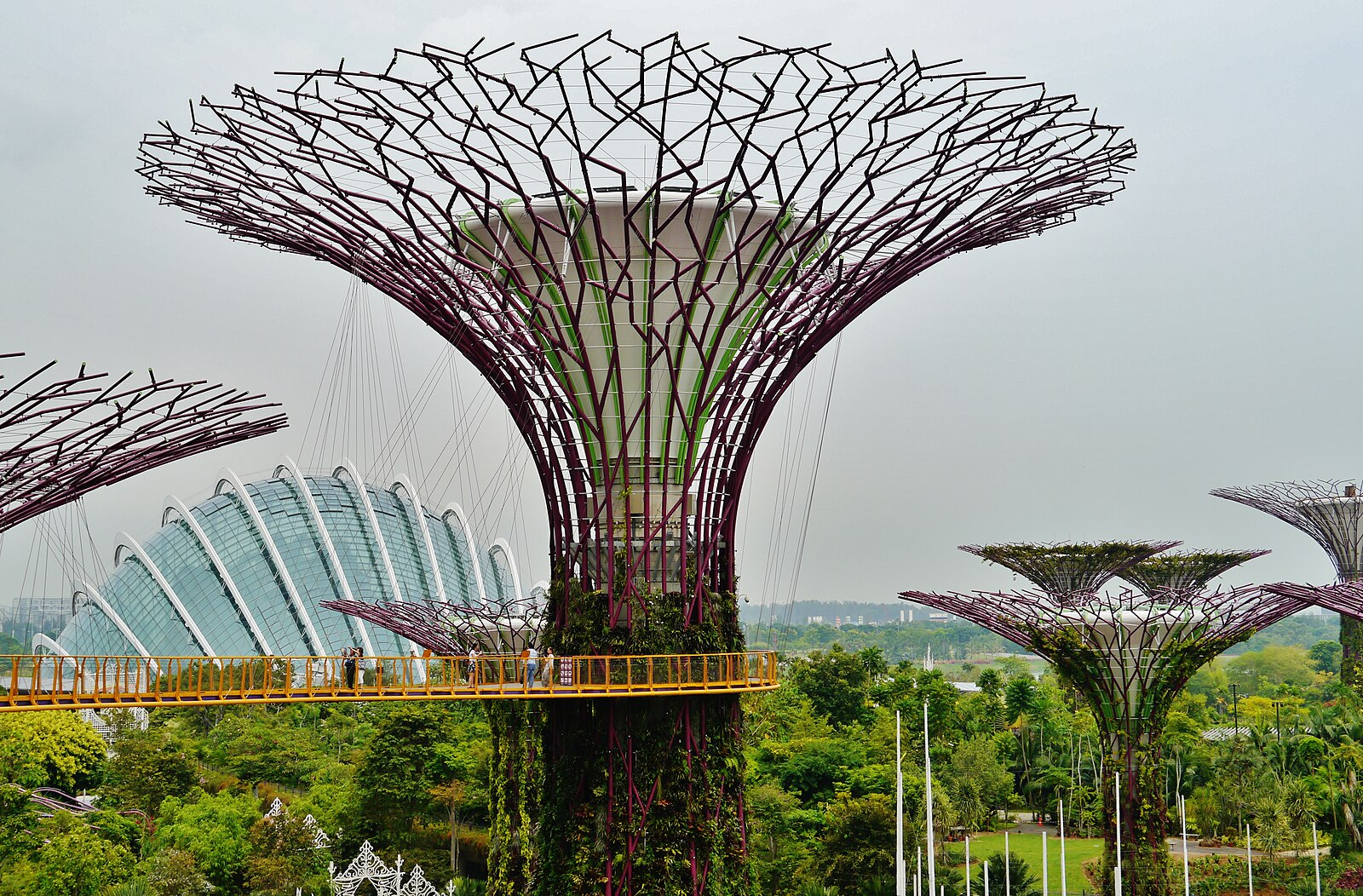
(Supertree Grove, in Singapore, uses natural shapes and non-imposing walkways, mimicking the shapes with large, artificial structures)
The Evolutionary Impact of Nature on Creativity
For the vast majority of humanity’s evolutionary history, we lived outside or among natural landscapes. As a result, we learned to trust or avoid the signals and stimuli we experienced from a variety of sources — much of which we must ignore in loud urban environments [2].
Human beings are incredibly adaptive creatures, and there are evolutionary impacts to living together in cities. Doing so provides safety, resource security, and other benefits, but returning to a quiet environment is calming.
Unlike natural environments, cities are loaded with stimuli that would be alarming in nature. Spending so much time ignoring the natural reaction to these may lead to cognitive fatigue, and relieving that may assist in boosting creativity.
Not only can the mind rest from tuning out the honks, yells, bangs, and crashes a city produces every second, but it can trust its intuition that these would be dangerous in this setting.
Inspiration’s Role In The Creative Process
In his 1926 book, “The Art of Thought,” the English social psychologist Graham Wallas attempts to examine creativity and the origin of thoughts in general. According to Wallas, Helmholtz’s story from the introduction details the “three stages in the formation of a new thought.” [6]
These are preparation, inspiration, and illumination:
- Preparation — Wallas argues that the time spent in “hard, conscious, systematic, and fruitless analysis of the problem” is a foundational first step
- Incubation — With knowledge of the problem secure, spending time “not consciously thinking about the problem” lets the mind wander to new potential solutions
- Illumination — Wallas refers to this as “the appearance of the ‘happy idea’”
Wallas also argues that a fourth period of “verification” should follow this, wherein the inspiree puts inspiration to the test before accepting it.
Writers, artists, musicians, and all other creative workers know the pain of looking at a blank canvas and trying to brute-force art onto it. The good news, according to Wallas, is that this is a great first step — now simply walk away from the canvas, enjoy life, have a happy thought, and implement it (after verification).
More often than not, it’s more beneficial to step away for an hour-long walk than it is to keep trying to kickstart the creative energies needed to finish.
What Is The Best Environment For Fostering Creativity?
The best environment for fostering creativity is anywhere you can experience nature and free yourself from tasks. There is a tremendous benefit to spending even just 20 minutes outside, but creativity benefits more from a “high dose” of nature and disconnection.
One study took 56 participants on an electronics-free 4-6 day hike and found a 50% increase in creative thinking after 4 days [7]. While there was a benefit from early on in the experiment, it continued to improve through this time frame.
Data suggests that everyone should spend an average of 15 – 25 minutes per week outside, and any nature is better than none. Still, there’s compelling evidence that retreat-type environments could create even bigger benefits for creativity.
Conclusion: Inspiration and Introspection From The Complexity of Nature
Natural environments are increasingly hard to find in America as state and local parks continue to close or fall into disrepair. Whether you’re a creative professional or work in an office all day (or both), finding ways to get outside is critical for working at your best level.
This may entail a week-long nature retreat to somewhere like Bask Retreat Center, or it might be as simple as a daily 20-minute walk (again, or both). Regardless of how it’s done, make sure to introduce nature into your daily life, and you’ll notice the creative results rapidly.
FAQ: Nature and Creativity
Here are some frequently asked questions about nature’s impact on creativity:
1. How Does Nature Improve Creative Thinking?
There are a few theories for how nature impacts creativity, but they all agree that natural environments are beneficial for boosting creative thought. The main reasoning behind this is nature’s ability to induce “soft fascination.”
These captivating sights leave plenty of room to let the mind wander while appreciating the beauty of life. Additionally, it may help to reset the cognitive fatigue of urban environments and extensive task lists.
2. How Much Time Should I Spend In Nature to Boost Creativity?
It’s a good idea to spend at least 15-25 minutes outside every day, but data also suggests that longer durations can be more beneficial.
Long-term options, like nature retreats, allow your brain to relax for multiple days and may boost creativity by as much as 50% after 4 days. Still, any time spent outside is helpful.
3. Where Are Good Places To Spend Time In Nature In Tennessee?
Tennessee hosts beautiful parks, hiking trails, campsites, lakes, mountains, flora, and fauna. Nature retreats like Bask offer great solutions as well, and offer a window into the natural beauty of the state with comfortable accommodations and areas dedicated to contemplation and meditation.
4. How Can I Include Nature In My Daily Routine to Help With Creativity?
The best ways to introduce nature into your daily routine are to dedicate time to being outdoors every day. Some also find it helps to introduce and care for plants into their creative or work space.
Ideally, it’s best to also regularly take longer breaks from urban environments, retreating for multiple days at a time.
References
1. Beveridge, W. I. B. (1970). The Art of Scientific Investigation. Heinemann.
2. Plambech, T., & Konijnendijk van den Bosch, C. C. (2015). The impact of nature on creativity – A study among Danish creative professionals. Urban Forestry & Urban Greening, 14(2), 255–263. https://doi.org/10.1016/j.ufug.2015.02.006
3. Kaplan, S. (1995). The restorative benefits of nature: Toward an integrative framework. Journal of Environmental Psychology, 15(3), 169–182. https://doi.org/10.1016/0272-4944(95)90001-2
4. Yeh, C.-W., Hung, S.-H., & Chang, C.-Y. (2022). The influence of natural environments on creativity. Frontiers in Psychiatry, 13. https://doi.org/10.3389/fpsyt.2022.895213
5. Sjövall, I. A. K., & Spiers, H. J. (2024). The Potential of Biophilic Design and Nature to Improve Health, Creativity and Well-Being. In S. Kühn (Ed.), Environmental Neuroscience (pp. 255–281). Springer Nature Switzerland. https://doi.org/10.1007/978-3-031-64699-7_11
6. Wallas, G. (2014). The Art of Thought. Solis Press.
7. Atchley, R. A., Strayer, D. L., & Atchley, P. (2012). Creativity in the Wild: Improving Creative Reasoning through Immersion in Natural Settings. PLOS ONE, 7(12), e51474. https://doi.org/10.1371/journal.pone.0051474


.jpg)